
The Ley line Group visits
the Cathedral of Chartres
Page One
at Home2b.nl

Go to Page 2 of the Chartres report
The message of the Templars
Go to Page 3 of the Chartres report
Many answers from the Building history
Go to
Page 4 of the Chartres Report
Message of the Templars -2-
Go to page 5 of the Chartres report
the Labyrinth

The Ley Line Group visits the
Cathedral of Chartres
Robert and Susan visited the Cathedral of Chartres south of Paris
together with other members of the Ley Line Group.
The cathedral of Chartres is very beautiful and different from any
other cathedral.
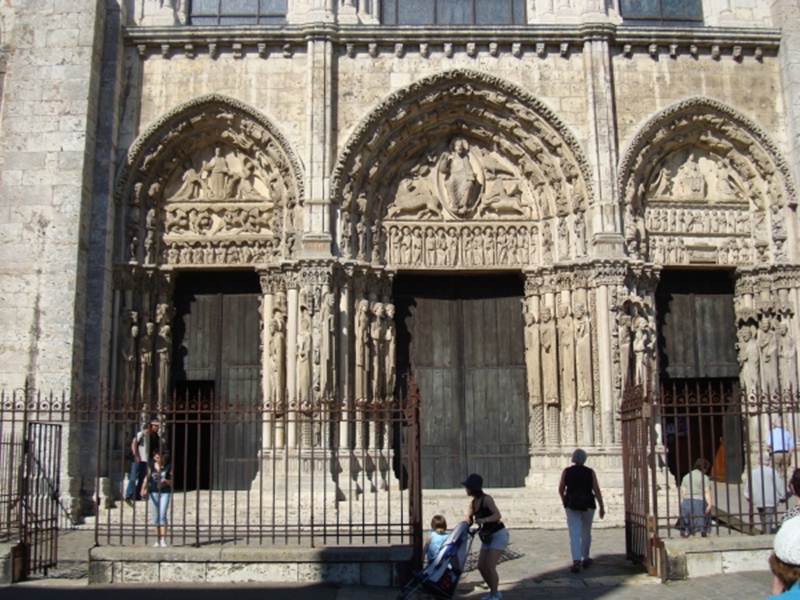
The West entrance or named Porte Royal.
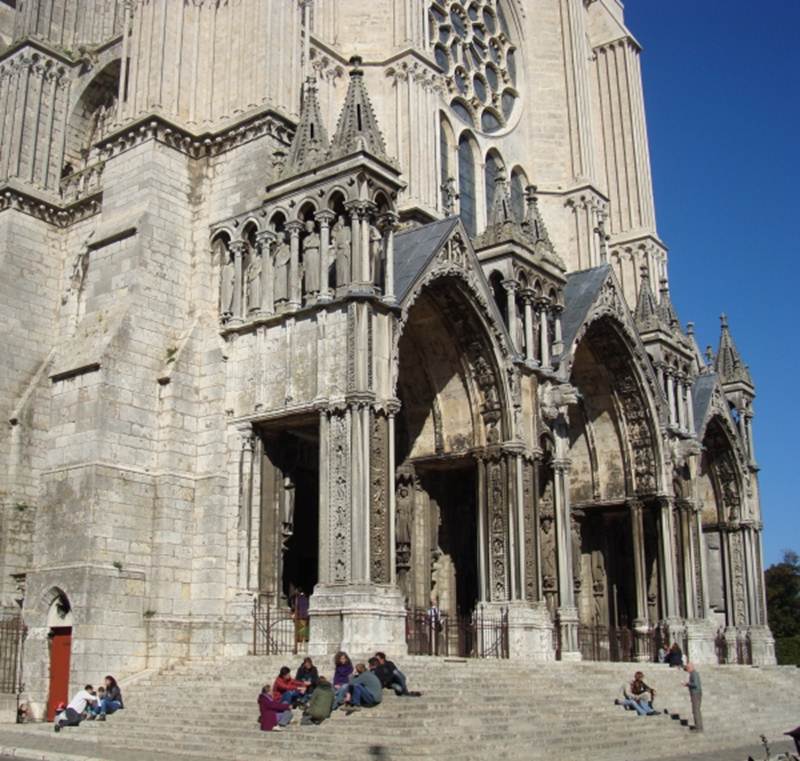
South Portal.
Unforgettable beauty when you look better and better.
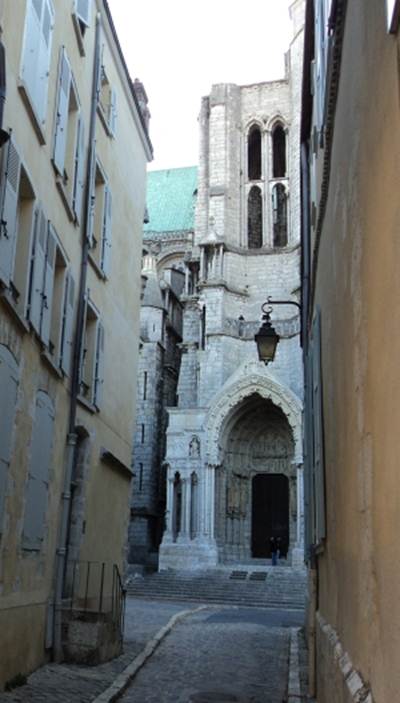
This little street opens the way to the North side of the Cathedral
of Chartres.
Very likely pilgrims coming from the North City Gate of Chartres
climbing up the steep Rue Muret
to come towards the cathedral along this little street of pebbles.
The goal of our
visits to the cathedral of Chartres
The goal of our visit was to find the creative spirit, the
inspiration
and the message of the Templars.
To find the hidden message of the Templars.
To solve the mystery of the financing of this cathedral and 20
others.
To see Alchemy symbolism and some signs of the Templar treasure.
The Templars were building 21 cathedrals in this area in a time
span of about 40 years.
Why this enormous effort and how could this be financed?
Where did all these stone cutters, builders and architects came
from?
Is there a message in all this from the Templars
towards us spanning the centuries?
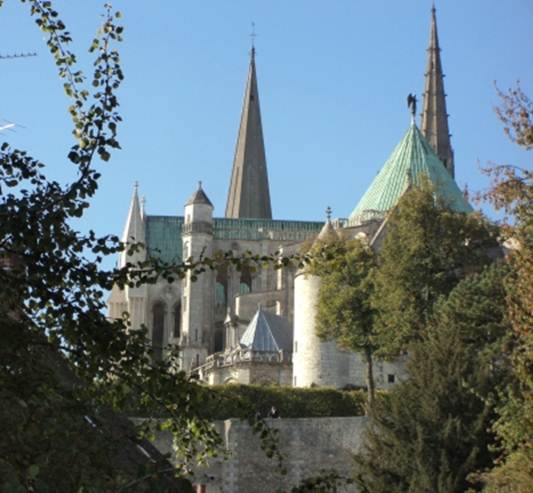
The North East side of the Cathedral has big walls going down about
40 meters in total.
The feeling of the Ley Line Group is
that an entrance towards a cavity inside the hill is hidden here.
There is enough space between the original soil of the building
place and
the floor of the cathedral, at least 12 meters
and may be much more.
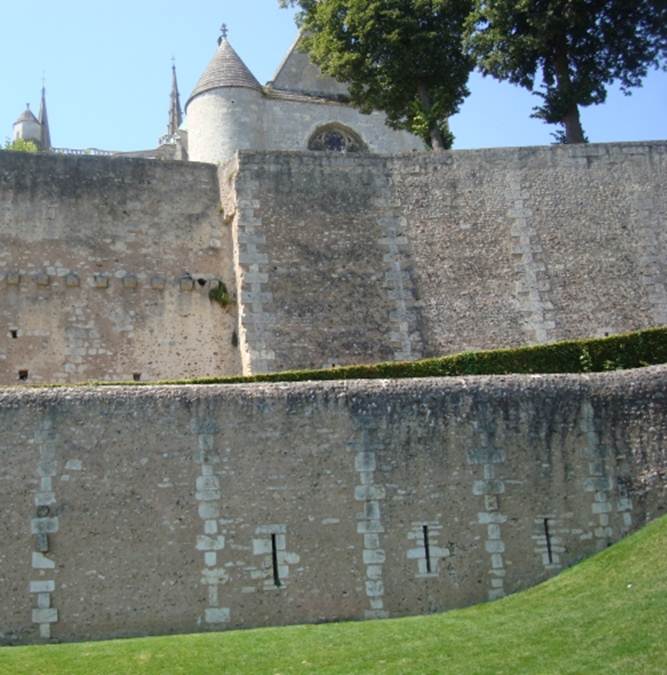
To fill up the original hill to a horizontal flat surface enormous
wall were made to
keep the rocks and dirt together.
The Ley Line Group has the strong vision confirmed by measuring
that
this vast artificial area below the cathedral has cavities and
cellars.
Even an entrance should be here somewhere.
Together we chose the Cathedral of Chartres as an object for study,
because the Cathedral of Chartres was given priority by the Templars.
This cathedral was finished in one big project
between 1194 and 1220AD
without break or financial hesitation within 26 years.
The Royal Portal was already finished in the years 1134 until
1194AD
The master builder of the cathedral had the building plan
ready to start construction within a year,
which gives an idea of the high priority of this cathedral!
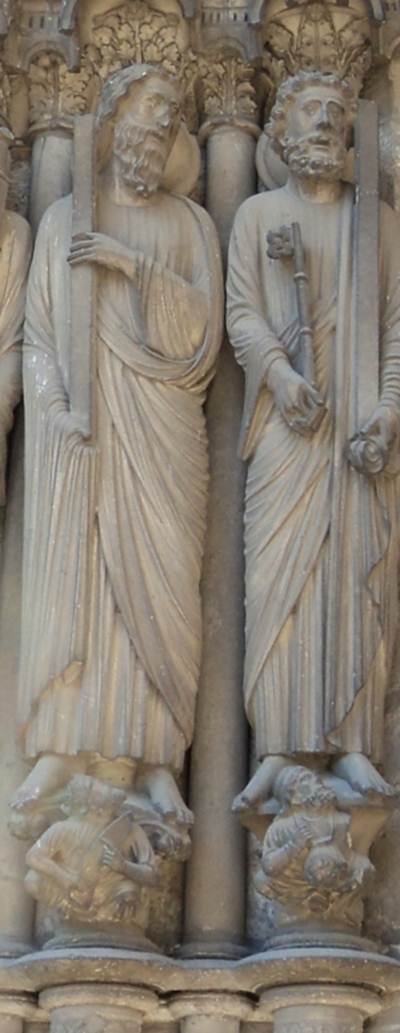
We measured the measure rod in the hands of the left figure very
precisely.
The measure indicates a cupid of 73.4cm or 734 mm.
The figure at the right has two keys in hand, very closely to each
other.
South Portal.
It seems to be one key, but it is not, it are two keys behind each
other.
We think that this is meant as an Alchemy symbol
for the White and the Red Stone.
The White Stone has the ability to create value.
This could be the answer to the financing question.
When we are standing next to the cathedral we get the idea of the
beauty
and the enormous effort put forth to erect this building.
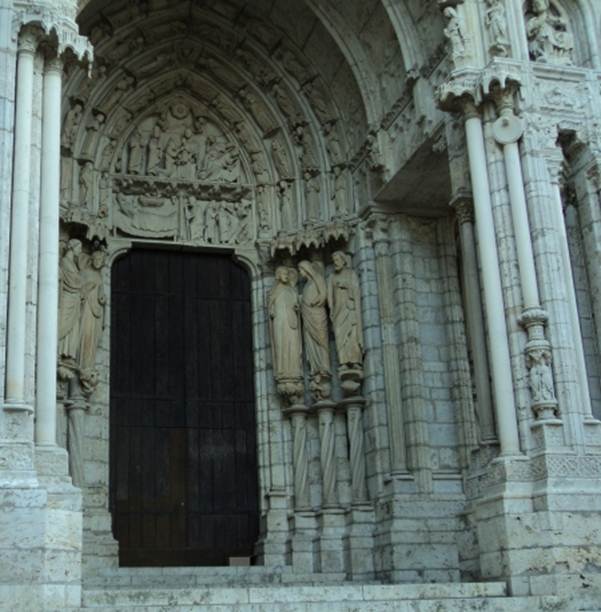
Northside middle portal.
Every statue has its own symbolism.
. We know that the stones for this building came from a nearby
quarry.
Pelgrims and local people were helping
to transport these raw stones to the building site.
When the stones arrived at the building site, the stones had
to be carved for their purpose and put into place.
Many stones had to be shaped into the beautiful sculptures
inside and outside the cathedral. All this activity resulted
in a stable and powerful structure.
Megalithic monument underneath the Cathedral of Chartres.
It was clear to the four researchers (Robert Susan Judith and Ron)
that deep inside the hill under the cathedral an ancient megalithic
building is hidden.
It even feels clearly, that a cavity is connected to this
megalithic ancient holy site
which is a so-called dolmen.
Julius Ceasar wrote about this dolmen in his book The War of
Gallia.
He writes that this dolmen is in a place called Saint Fort.
This is also a name used for the hill under the cathedral.
The healing well in the crypt of the cathedral is also called Well
of Saint Fort.
The healing well is 34 meters deep and is square in some places.
This could indicate that the well was constructed into a deep cave,
which means not drilled into the rock but naturally inserted into a
cave.
The hill upon which the cathedral is built is cone shaped.
The top is about 70 to 80 metres high above the surroundings.
The diameter at the foot of the hill is about 800 metres.
So there is enough space inside the hill for some cavity.
The North East side of the hill is very steep with walled gardens
connected by staircases.
Our feelings very strong, that an entrance to a cavity
is on this steep side of the hill, maybe even as part of a private
house built into the hill.
The ancient dolmen of which we feel the existence and
that is described by Julius Caesar is somehow integrated
into part of a cellar below the crypt of the cathedral.
The stones of this ancient temple are too hard to be handled by
medieval builders
which indicates the ancientness of this temple.
In ancient times builders had the knowledge to handle this kind of
stone,
but the medieval builders of one of the five cathedrals of Chartres
could not have done this,
because they did not have to knowledge and means to handle this
type of hard stone.
These stones can be seen in the area of the chapel of Saint Lubin.
This chapel is part of the Carolingian ruines below the remnants of
the Fulbert cathedral.
See page 3 of the Chartres report.
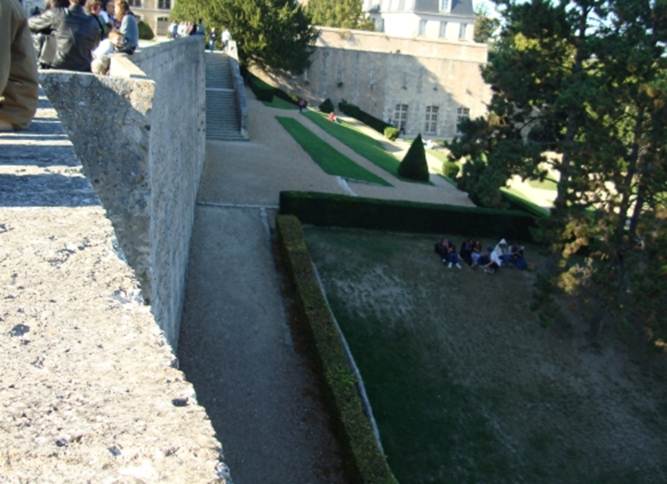
On the Eastside steep walls go down.
This illustrates the height of the hill of Saint Fort
on which the cathedral is placed.
Very likely the level down this wall is the original building level
of the dolmen
and the Jupiter temple plus the later Merovigian cathedral.
The soils and bottom of the cathedral in the centre of the building
has never been researched. Radar measurements of the middle part
of the cathedral indicate in several places ancient constructions.
Radar pictures are normally too vague to see any shape or
structure.
Anyway these measurements mean that there is a structure of hard
stone
in the middle part of the soil under the cathedral in apparently
two places.
Black Madonna is Saint Anna with God the Child.
The cathedral is erected around the Black Madonna.
This Madonna is not Saint Mary, but Saint Anna the Mother of Mary.
The child she is holding is God the Child.
These are venerations coming over out of the original religion of
Europe.
In the Old European writing the name is: Λ
This writing has not been translated yet,
but in our opinion it is clear that Λ means A or Anna.
(So in a way here is the same situation as in the church of Anloo,
where also a hunebed is built into the little church which was
built by Saint Liudger.
This church at Anloo is also a place of the ancient Goddess Anna,
from where the name Anloo comes.)
Prof Marijah Gimbutas has uncovered the fact that the Goddess with
the “A”
was already venerated 9.000 years BC and that the Goddess A
was venerated through all ages until apparently today.
When the writings of the Old European language will be translated
in the future,
we will perhaps know more about the ancient Goddess A.
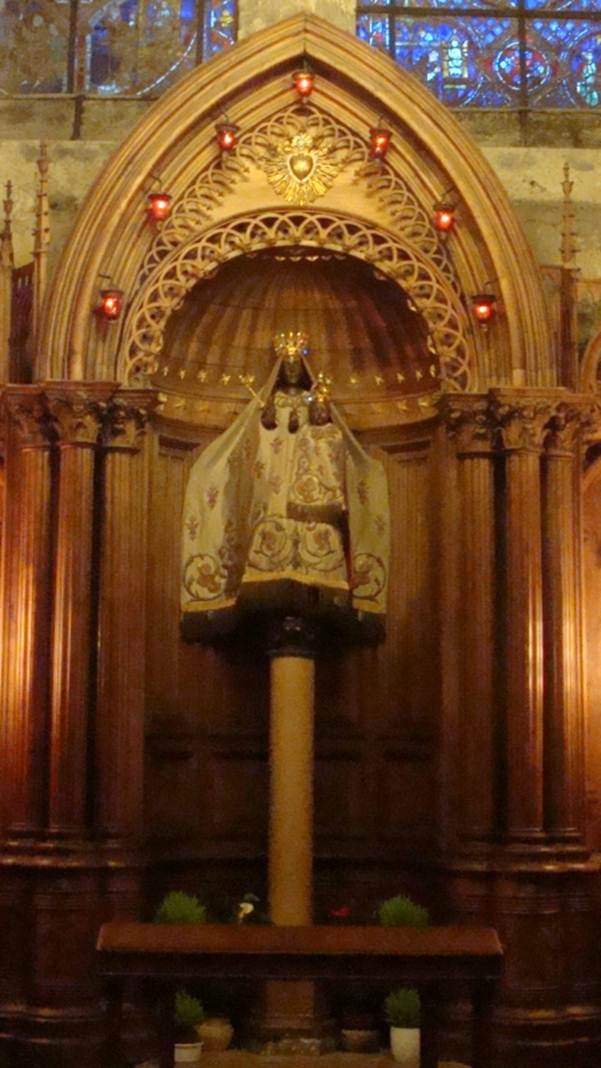
The black Madonna on the Pillar inside the cathedral.
Pelgrims are touching the pillar for healing and miracles.
The Black Madonna is seen as Mary carrying Jesus.
Important is that also other churches of the Templars
had very prominent chapels for Saint Anna.
The Temple Church in London had a very big Saint Anna Chapel
connected to the choir.
The veneration of Saint Anna is a characteristic of the Templars!
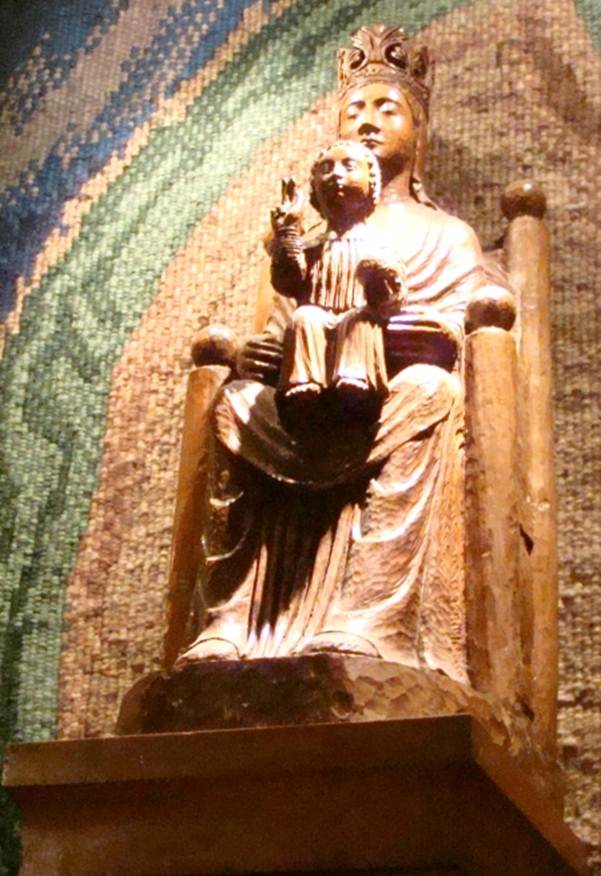
The other Black Madonna of Chartres is the Madonna in the Cellar.
The Cellar is the crypt and the ancient floor level of the fulbert
cathedral.
In Utrecht (the Netherlands) we found a Mary in the Cellar
veneration
that had vanished together with the Salvator cathedral,
although the Leyline Group measured that the cellar still must be
below the surface.
Also we found the strong impression a Jupiter Temple below the Dom
cathedral next to it.
See the special page about the visit to
Utrecht.
No burials or dead bodies inside the Cathedral of Chartres.
Very peculiar and important is the fact that no burials
ever took place inside the cathedral. No buried martyr or
saint is to be found in the whole building complex.
This means that any entities that were taking up contact
during our visits at the cathedral were “real” entities,
not local people who stayed with their grave,
but entities conveying messages about the place and its meaning.
They could be Guardians or Receivers (Paralemptor).
Why are there no burials in the cathedral?
This could be connected with the Black Madonna belief:
Saint Anna and Saint Mary
Professor Marijah Gimbutas writes a lot about the Goddesses With A and
M.
In the ancient Goddess tradition there were also no burials.
The message of the entities in the South Portal.
When Robert is spoken to by entities in the South Portal,
they have a real message. The message is nevertheless unclear.
The message is about the fighting around Jerusalem.
The message is about Alchemy.
The message is about the Mother saving the souls in cooperation
with God the Child.
The Labyrinth inside the Cathedral of Chartres
connected with the Vortex of Rebirth and Eternal Life
The cathedral of Chartres has the very remarkable Labyrinth.
The labyrinth almost surely played a role in an ancient procedure
of finding eternal life.
The shape of the labyrinth is certainly like a vortex.
This labyrinth could be related to the feeling of the ancient
dolmen below.
Megalitihic monuments were meant to emplify the Vortex they
embraced and surrounded.
The Gothic architecture also has a relation with Vortex energy.
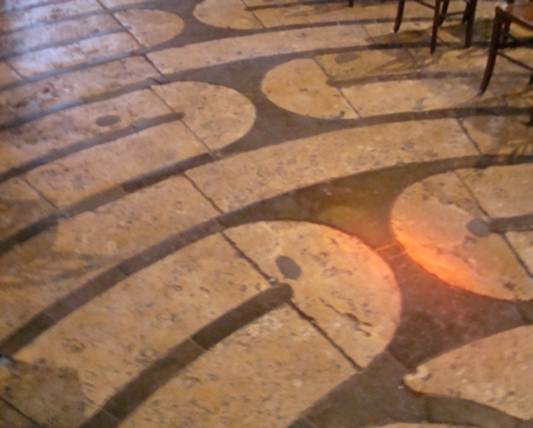
The labyrinth of Chartres is beautifully inlaid with black and
white stone.
Normally the labyrinth is covered
with rows of chairs
more or less to hide the labyrinth.
Only a few hours a week the labyrinth is uncovered.
See the
special page about the Labyrinth.
(Page 5 of the Chartres Report)
Go to Page 2 of the Chartres report
The message of the Templars
Go to Page 3 of the Chartres report
Many answers from the Building history
Go to
Page 4 of the Chartres Report
Message of the Templars -2-
Go to page 5 of the Chartres report
the Labyrinth

You
may e-mail:


Updated August 05, 2012
Everything on this website:
Copyright©2002-2012 by Robert and Susan