
Goddess Page
The Ley
Line Group visits ancient Anloo
at Home2b.nl

The Ley Line Group visits ancient Anloo.
It comes out that Anloo is a Goddess sanctuary of 8 by 6 kilometers.

When
the date of the Anloo visit was definitive,
Robert
started having strong visions of Anloo,
although
he had never been there, at least not in this life.
Robert
always has strong and almost violent visions
when
the megalithic goddess culture is involved.
Apparently
an earlier life of Robert took place in the megalithic world.
During
several nights Robert saw the church of Anloo being built
upon
a large megalithic sanctuary.
The santuary
consisted of a so-called “lang-graf”,
which
is a stone room like a large “hunebed”,
plus
a temple offering place,
and a
holy circle, and also a larger enormous
“image”
connected to the Goddess.
The
name of Anloo comes from the Holy Wood of An or Anne.
Many
“long-graves” or stone rooms are known in Western Europe.
South
of Anloo are the megalithic sites D7, D8 en D9
where
the Ley Line Group will measure
remarkable
things.
Nearby
Anloo is the village of Rolde situated,
where
also several megalithic “hunebed” sites are known.
Also
the judging place the “Balloerkuil”,
which
means the "Dell of Balloo" is nearby.
At
this judging place Robert got once a big vision
of a
megalithic trial going on, with a lot of megalithic
and
local people attending.
Rolde
has since been a place of attention for Robert.
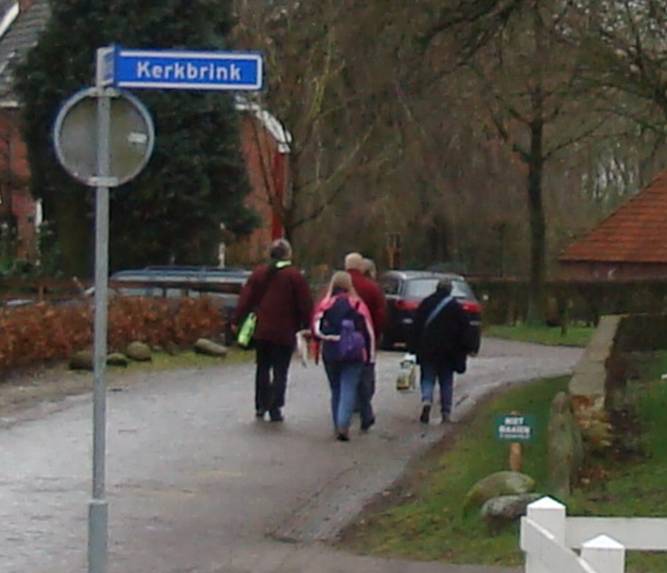
The Ley Line
Group on the march.
To the right is
a large flat stone to be seen,
characteristic
of the structure of a "Long grave",
a megalithic
Long Grave, consisting of a Hunebed with stone walls,
something like a
very large stone coffin.
This stone along
the road has apparently been broken of
of the Longgrave
upon which the church of Anloo has been built.
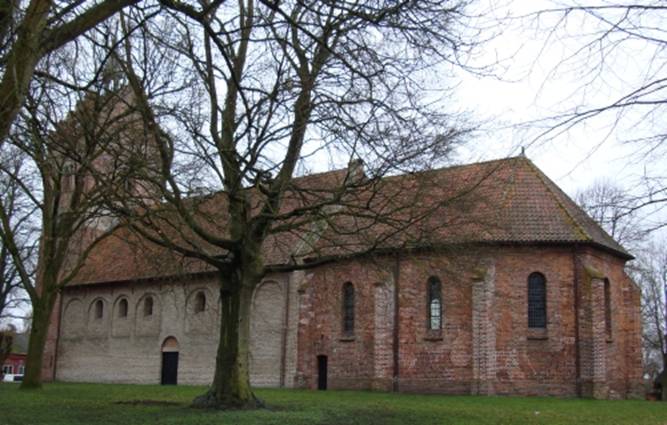
The church at
Anloo.
The middle part
has walls of 1,5 meters thick and is strong like a fortress.
The arched door
in the middle part is the South entrance where the very large
"Langgraf"
hunebed was situated (and is still situated in the hill
upon which the
chrurch is located).
The choir to the
right was added centuries later
when
Christianity had taken over the fortress building in the middle.
The
church of Anloo is situated upon a round hill
of
approximately 2 meters high.
Since
there are no inundations in this area,
this
hill must have been for other reasons,
like
old remnants covered up by a layer of dirt.
The
tower is clearly built in many phases,
getting
higher through the centuries.
Around
the tower big stones can be seen,
confirming
that at least the tower
is
built upon megalithic remnants.
On
the terrain are also very large flat megalithic stones
to be
seen. Those stones are characteristic for
the
structure of a Long Grave.
The
middle part of the church is made of natural stone
most
likely coming from Bentheim, about 70 kilometers away,
with
walls of 1.5 meter thick. The doors are protected by sliding beams.
The
fortress part of the church has been build between 720 and 900AD.
Archeology
confirms that on exactly the same place as the stone fortress
five
earlier wooden fortresses were build
with
the same size and the same rectangular shape.
This
brings the dating back towards the arrival of
the
Irish missionaries in the Northern Netherlands around 650AD.
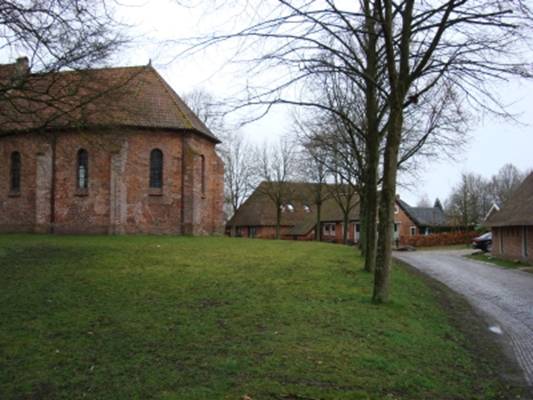
The hill around the
church is clearly visible.
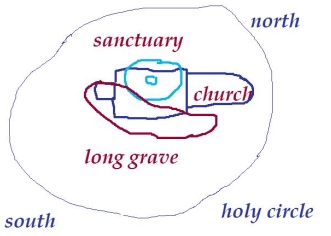
(drawing
by Robert)
The hill around
the church and the holy Megalithic circle around
the Long Grave
are more or less the same.
Very probably
the holy circle around the original megalithic site is still there
and the hill is still
the original hill of the megalithic holy place.
The
restauration of the church being done around 1950 has made
the
fortress middle part of the church look like a building in Roman style,
So
the Roman style appearance of the fortress is
no
indication of the real history of the place.
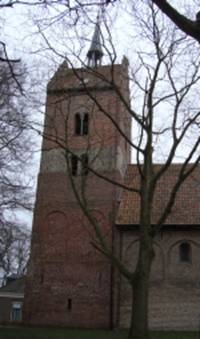
The tower is
build literally upon the North corner of the Langgraf hunebed.
The different
types of brick in the tower walls clearly indicate,
that the tower
was build during long periods of time.
Originally the
tower was as high as the fortress building.
Only one little
window exists in the down part of the tower.
May be an extension
of the fortress,
after the
takeover of the Christians around the year 1100?
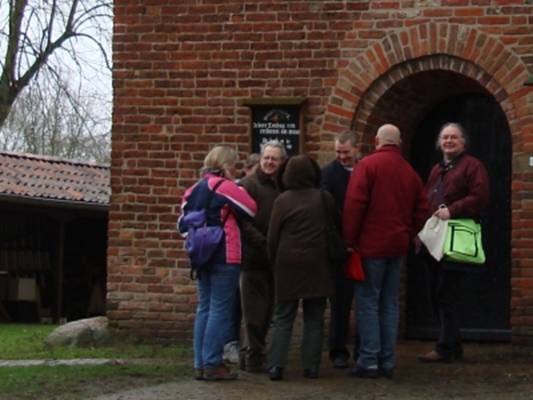
The Ley Line
group entering the church through the tower.
Most of Roberts
findings are confirmed by other members.
An enormous stone
is visible at the corner of the tower.
The stone is
part of the wall, not lying besides the tower.
The tower is
clearly built literally upon the megalithic site.
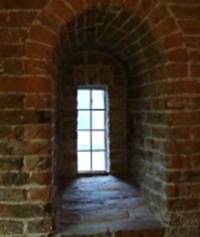
The inside of
the tower window
in the original
part of the tower.
Robert
was able to do measurements with the Lecher antenna.
1.1 cm waves for Holy Place confirmed
17.7 cm for Goddess Place and Divinity present confirmed
3.4 cm for Gateway to Afterlife confirmed
6.3 cm for Altar Place confirmed
8.5 cm for cellars and Dimensional Gateway confirmed
The
6.3 and the 17.7 wavelengths came together
in a
place just inside the fortress at the Northern entrance.
This
indicates an important central megalithic altar place.
The
Northern entrance is in recent times closed with bricks.
Above
the Northern entrance is a sarcophagus coffin
placed
in the wall on the Northside of the fortress.
This
could be part of the taking over by the male nobility and clergy.
The
taking over of the megalithic holy place by the christians
is
also a change of matrimonial culture towards male dominated society.
The
erasing of the Goddess Anne and the taking over by the
male
dominated Christian culture like it has been propagated
by
the Roman Catholic clergy.
The
sarcophagus above the original entrance is emphasizing
this
new authority.
On
the inside of the fortress is an enormous piece of furniture placed
against
the Northern entrance. It feels as if the set-up
is
meant to keep the strong influences of the ancient holy place outside.
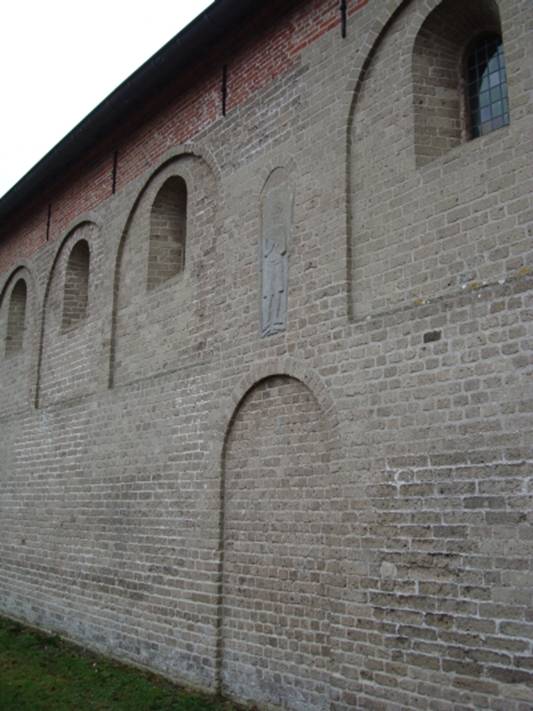
The North
entrance of the fortress.
Closed and
apparently sealed for ever.
The
Northern entrance is very likely the entrance
to
the ancient Goddess sanctuary.
The
entrance into the “Long Grave” stone room
must
have been on the South Wall of the fortress.
In that
area is a sarcophagus placed in the tiles of the floor.
The
fortress seems to be have been built as a means to preserve
the
holyness of the Goddess fortress
against
the change of the civilization and the culture.
In
the North Eastern corner of the fortress
Robert
felt the former presence of a healing well.
Other
members of the LLG confirmed that three water lines
were
coming together at that place
in
the North East corner of the fortress.
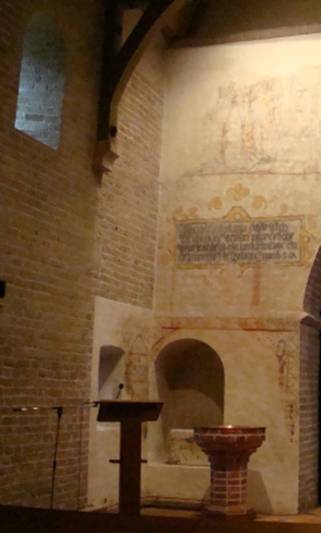
Corner where
Robert sensed a healing well.
Three underground
water lines are coming here together.
Remarkable that
the baptism water basin is in that same place.
Ancient Anloo is a very large
Goddess complex.
Around the village of Anloo an
ancient image of the Goddes is to be seen
in the pattern of ancient
roads around Anloo.
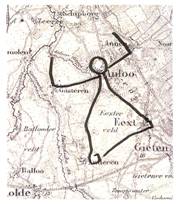
(sketch made by
Robert)
This sketch is the result of Roberts
research of old maps.
The image is estimated 8 by 6
kilometers.
Clearly the Goddess Anne is the
Birdgoddess with the X-shaped body
and the bird shaped hands and feet.
The Birdgoddess has been named A since
300.000BC,
see the works of Marijah Gimbutas.
The church of Anloo with the
ancient "Lang graf" or Long Grave and the
circular sanctuary at the
North entrance of the Long Grave
are at the "chin" of
the Goddess image.
Were these ancient roads in
the image of the Goddess
used for processions towards
the sanctuary?
In the Ley Line Group Ron is
the expert for procedural visions
and ceremonial entrance
rituals.
He confirms this thought about
processions along the Goddess roads.
Do you have visions or
measurements at Anloo?
Or do you have knowledge about
the Goddess roads
around Anloo and the villages
Annen and Anderen?
Let us know!

You may e-mail:


Updated October 11,
2011
Everything on this website:
Copyright©2002-2011 by Robert and Susan